
Dubuque County Arrest Warrants Explained
An arrest warrant is a judge's order telling peace officers to bring a named person into custody. In Dubuque County, that power flows from Iowa Code Chapter 804. A criminal case there can begin when a complaint goes to a magistrate. The complaint and any affidavits must show probable cause that a crime happened and that the named person did it. Meet that test and the magistrate signs, unless a citation or another lawful route fits instead. Arrest warrant records then sit inside the unified Iowa District Court system. A district judge, district associate judge, or judicial magistrate may issue, each acting within the authority Iowa law assigns. The Clerk of Court keeps the docket but never rules on probable cause. Police bring facts; a judicial officer weighs them; law enforcement serves the signed order later. Remember that split when you pick up the phone in Dubuque County. Calling the clerk about a probable-cause question gets you nowhere fast.
Confidential Dubuque Arrest Warrants
A clean online result does not clear anyone of a new Dubuque County arrest warrant. Iowa Code §804.29 keeps the papers filed to get a warrant confidential until arrest and return, or until the defendant's initial appearance, unless a court orders otherwise. The rule can cover the complaint, the citation, and the affidavit behind the probable-cause finding. It shields the investigation and the service plan. So where do you turn? The Dubuque County Attorney FAQ offers a direct local route. It tells anyone who suspects a new-charge warrant to contact the local police department and arrange surrender, because the Clerk cannot hand out pre-arrest material. A lawyer can call the agency for you and map the next steps. A missed court date in a case already public is a different chore entirely; that one goes to the Clerk at 563-589-4418. Two situations, two channels. Note: Iowa Courts Online is a public docket index, not a complete or real-time Dubuque County arrest warrant search.
Inside a Dubuque County Arrest Warrant
The warrant itself and the docket that follows can show where a Dubuque County case stands without unsealing protected material. Iowa forms carry a District Court caption and a criminal case number. They command peace officers to act. A judicial officer signs and lists an official title. After service, the public index may add charge, bond, return, and status entries. The exact fields shift with the stage of the case.
| Case ID | A 17-character Iowa identifier, often using FE, CR, AG, SR, SM, or OW to mark case type. |
|---|---|
| Named person | The person whom the judicial officer directs peace officers to arrest. |
| Charge | The offense, count, description, and classification when those details are public. |
| Issuing officer | The district judge, associate judge, or magistrate who signs the order. |
| Service return | The agency or officer serving the warrant and the recorded service date. |
| Bond | The set amount, type, posted amount, poster, and disposition when entered and public. |
A case code alone says nothing about warrant status. Read the docket events, then confirm the current result with the Dubuque County Clerk or the agency.
Dubuque Arrest Warrant Service Roles
More than one agency can execute Dubuque County arrest warrants. The Dubuque County Sheriff's Office handles county functions and runs the jail. Dubuque Police serves the city through patrol and investigations. An officer anywhere in Iowa can act if the person turns up elsewhere. County dispatch routes calls, but it keeps no court records and cannot hand you a legal status. The official Dubuque Police page shows the city department working out of the shared Law Enforcement Center. That arrangement explains why police, sheriff, jail, and dispatch all touch the custody process in Dubuque County while the District Court stays the issuing authority. The city's listed contact reaches an agency, not the Clerk's docket confirmation. Use each door for what it actually opens.
Serving Arrest Warrants in Dubuque County
Officers can serve a Dubuque County arrest warrant several ways. They may find the person during an investigation, at a known address, or through another lawful contact. A planned surrender works too. The warrant authorizes custody; it settles nothing about the charge. After arrest comes booking, and the person goes before a judicial officer without needless delay under Iowa procedure. The officer then files a return recording execution. That event can unlock the public docket, since §804.29 ties confidentiality to arrest and return or the initial appearance. The court next takes up identity, counsel, release conditions, and a future date. Timing depends on the charge and the court calendar. Walk in expecting release and you may wait; no official Dubuque source promises that.
Dubuque Arrest Warrant Timeline
A Dubuque County warrant moves through many hands on its way to court. Each step has its own source of information, and no single portal covers the whole chain.
- Police submit a complaint or sworn facts supporting probable cause.
- A District Court judicial officer reviews the filing and may issue an arrest warrant.
- The pre-arrest support stays confidential unless the law or court permits release.
- A peace officer serves the order, or counsel coordinates a surrender with the agency.
- Booking and an initial appearance lead to a bond or release decision and new docket entries.
- The criminal case continues after the warrant stage; custody does not decide guilt.
The shorthand is complaint → probable-cause review → warrant → service → booking → initial appearance → court case. A reader should save the case ID and every written release or bond order.
Comparing Arrest, Summons, and Bench Warrants
Arrest warrants, summonses, and bench warrants can all land in the same District Court docket. They exist for different reasons, though. Match your response to the instrument in Dubuque County, not to a broad label.
| Feature | Arrest warrant | Summons or citation | Bench warrant |
|---|---|---|---|
| Starting point | Probable cause for a criminal charge | A command to appear without immediate custody | A missed date or unmet court duty |
| Immediate force | Authorizes arrest | Directs later appearance | Authorizes custody to return the case to court |
| Public timing | Support may remain confidential before service | Filed citation may appear after entry | Often appears as an event in an existing case |
| First route | Police and counsel for surrender | Follow the stated court date | Clerk for case status and court instructions |
A search warrant is a different animal. Chapter 808 authorizes a search for evidence, not an arrest in Dubuque County.
Dubuque Arrest Warrant Bond Steps
Bond in Dubuque County answers one question after custody: release. The uniform bond schedule is a starting point under Iowa law. It can apply when courts are closed and the arrest involves no forcible felony. The published amounts step down by offense class: $25,000 for a Class B felony, $10,000 for Class C, $5,000 for Class D, $2,000 for an aggravated misdemeanor, $1,000 for a serious misdemeanor, and $300 for a simple misdemeanor. A judicial officer may set a different amount under Iowa Code §811.2. Some offenses also require judicial review before any bond is accepted. The Iowa uniform bond schedule spells out those limits alongside its amounts.
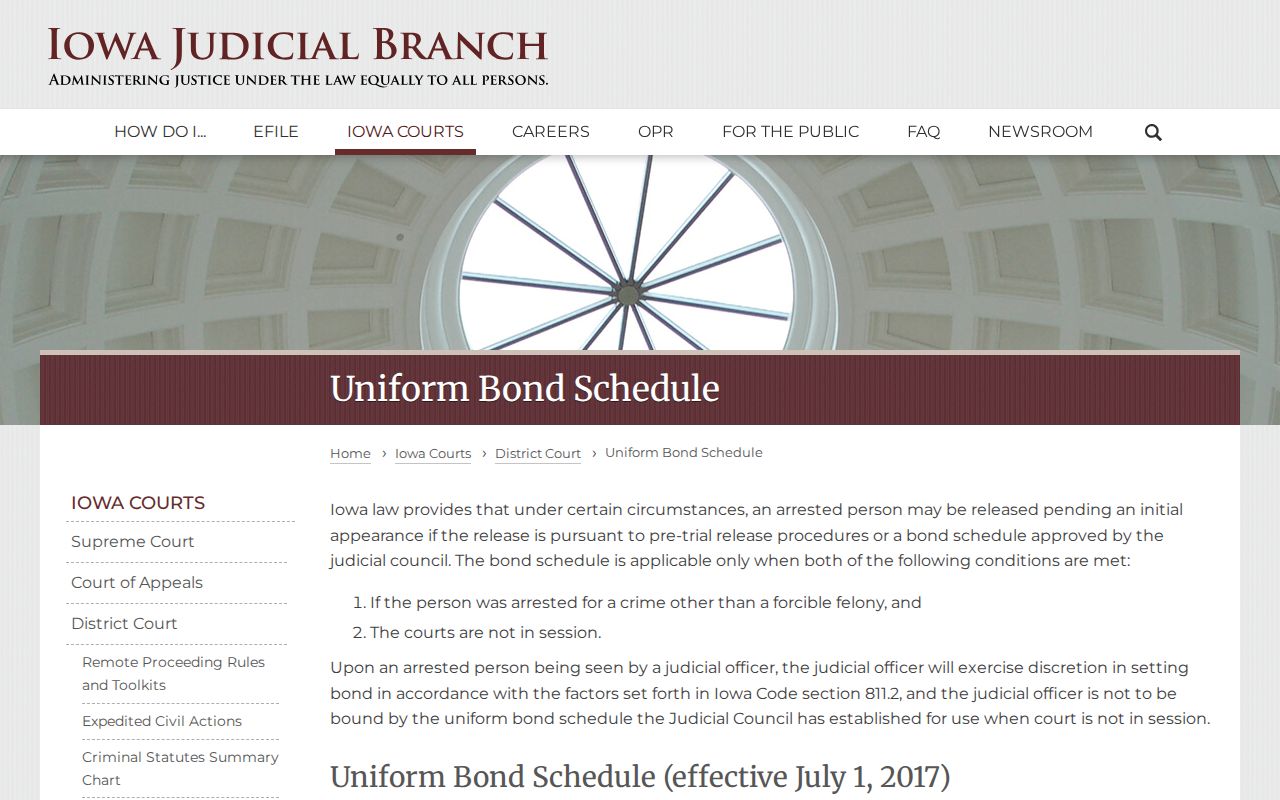
Treat the schedule as a floor rule for certain arrests. It is not a quote for a specific Dubuque County warrant. Confirm the signed order with the Clerk or the jail. Cash, a court-authorized ten-percent cash amount, or a surety bond may be possible. Posting bond can obtain release. It does not dismiss the charge or cancel the next court date.
Dubuque Arrest Records After Service
Once a Dubuque County warrant has been served, the case starts leaving a trail. Iowa Courts Online supplies free public index information after a case becomes available. You can search by name, date of birth, county, case ID, or citation as the system permits. A terminal at the courthouse may show more. Public documents and extra fields sometimes appear only there. The index itself is not the official record, though. A certified or official document comes from the Dubuque County Clerk. Read the entries closely. Look for the charge and count, the assigned judge, filings, events, bond entries, the service return, the status, and the next setting. A served entry means execution was recorded, while recalled or quashed means the issuing court withdrew or set the order aside. Do not treat a blank search as proof. Juvenile records and sealed material stay outside ordinary public access. Note: Keep the docket confirmation, bond receipt, and next court date together, since each answers a different part of the case.
If There's an Arrest Warrant for You
If a new-charge Dubuque County arrest warrant may be out for you, speak with a criminal-defense lawyer first. Then contact the local police agency about a safe surrender. Ask concrete questions. Who will receive the person? Is booking expected, and when might an initial appearance occur? How can the current bond order be confirmed? The Dubuque Public Defender's Office at 563-582-0750 is listed by the County Attorney. Appointment there generally follows a financial affidavit and court process. Never assume an online payment, a deposit, or arrival at a counter recalls the warrant. Only the issuing court can do that. A motion to recall or quash asks that court to withdraw or set aside the order. Dubuque publishes no warrant-only form, filing fee, amnesty date, or guaranteed walk-through. Counsel can file the motion and coordinate with police. For broader steps, the Dubuque County warrant records overview covers the Clerk, court, surrender, and confirmation routes.
Act carefully: Arrange legal advice and agency contact before surrender; confirm bond and the next hearing from an official Dubuque County source.